Scientific Principles, Restoration Technologies, and Evidence-Informed Field Decisions
October 2026
Affiliation: Novaco Restoration & Construction Ltd., British Columbia, Canada
Article type: Technical narrative review and illustrative decision framework
Download Full Technical Paper (PDF)
Abstract
Water intrusion creates coupled challenges of liquid-water removal, moisture transport, environmental control and material-specific recovery. Surface appearance alone cannot reliably establish whether a building assembly has returned to an acceptable moisture condition. This technical narrative review synthesizes publicly accessible guidance from ANSI/IICRC S500-2021, ASHRAE, the U.S. Environmental Protection Agency (EPA), and the World Health Organization (WHO) to develop a practical framework for structural drying and moisture verification. Major topics include capillary transport, vapour diffusion, air leakage, evaporation, refrigerant and desiccant dehumidification, moisture mapping, instrument limitations and drying endpoints. An explicitly illustrative decision scenario shows how practitioners can use successive observations rather than calendar-based assumptions to guide equipment adjustments and evaluate material salvageability. The review concludes that defensible drying decisions require identifying the source and extent of water, controlling contamination, using material-specific measurements, interpreting environmental readings, and documenting results against appropriate reference conditions. It does not establish comparative drying rates, universal drying times or experimental superiority of particular equipment.
Keywords: structural drying; water damage restoration; moisture control; psychrometry; moisture mapping; building assemblies; dehumidification; drying verification.
1. Introduction
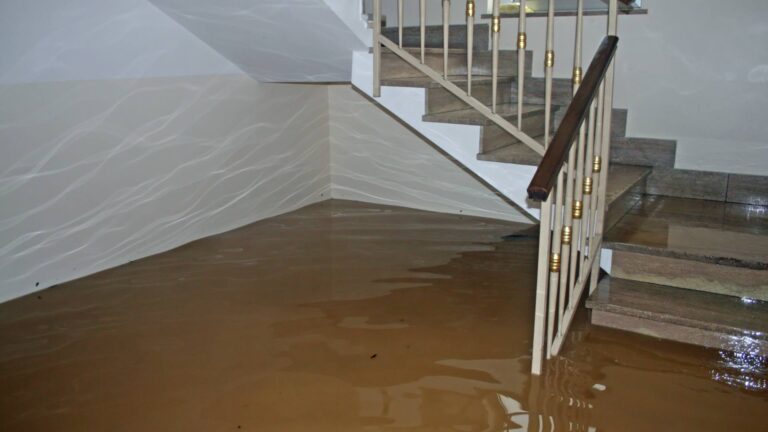
Water intrusion in occupied buildings may arise from plumbing failures, roof leaks, wind-driven rain, appliance releases, sewer backups or flooding. Water can move beyond visible staining and accumulate in finishes, framing interfaces, subfloors, cavities and insulation. Some components are accessible for evaporation and inspection; others are shielded by impermeable coatings or multi-layered assemblies. A single dry-looking surface is therefore insufficient evidence that all relevant materials are dry [1, 2].
Drying matters for durability as well as indoor environmental quality. The WHO review of dampness and mould identifies persistent dampness and microbial growth as conditions that should be prevented or minimized, and reports associations between damp indoor environments and respiratory symptoms and other adverse outcomes [3]. The association does not establish that every short-term water event produces those outcomes. The EPA likewise recommends source control and appropriate investigation of damp materials as part of moisture management [4].
Professional restoration differs from ordinary air-drying: the practitioner must assess the event, manage any hazards or contamination, establish measurable objectives, select suitable intervention methods and verify progress. ANSI/IICRC S500-2021 identifies building and material science, psychrometry, drying technology, equipment, documentation and project evaluation among its areas of practice [1]. This paper interprets these general principles alongside building-science guidance; it is not a substitute for reading the full licensed standard or for site-specific engineering, occupational hygiene or remediation advice.
2. Review Scope and Method
This is a narrative technical review, not a systematic review or a clinical-style meta-analysis. Sources were purposively selected for their relevance to professional restoration and moisture physics: the published scope of ANSI/IICRC S500-2021 [1], ASHRAE Handbook material on moisture management [2], WHO guidance on indoor dampness [3], and EPA guidance on moisture control and mould cleanup [4, 5]. Publicly available descriptions were used where full copyrighted standards were not available for independent verification. No comprehensive database screening, quality-weighted evidence synthesis or experimental reanalysis was performed.
The framework below distinguishes three kinds of statements: established building-physics principles, operational guidance summarized from authoritative publications, and professional decision considerations requiring project-specific verification. The hypothetical scenario in Section 8 is a teaching example, not reported field evidence. This separation avoids overstating what the cited materials demonstrate.
3. Physical Mechanisms of Moisture Movement
3.1 Liquid water and capillary uptake
Gravity can transport free water through open paths, while capillary action can draw it into porous materials and narrow interfaces. Gypsum board edges, wood-based sheathing and absorbent finishes may take up water even when the exposed face appears only lightly affected. Liquid transport is influenced by pore size, wetting characteristics, exposure duration and available drainage paths [2, 4]. Rapid extraction and stopping the water source reduce ongoing wetting but do not prove that absorbed moisture has been removed.
3.2 Vapour diffusion and air movement
Water vapour tends to diffuse in response to a vapour-pressure gradient. Air leakage can simultaneously transport substantial quantities of moisture-laden air through cracks and penetrations; the relative importance of these processes depends on pressure, temperature, permeability and assembly design [2]. The word “breathing” is not a reliable explanation for actual transport mechanisms. The drying plan should account for cavities, vapour-resistant layers and accidental air paths rather than assuming that all wet materials exchange moisture freely with room air.
3.3 Evaporation, temperature and relative humidity
Evaporation occurs when water leaves a wet surface as vapour. The process depends on available energy, exposed wet surface, local airflow and the difference between the moisture condition at the material surface and that of the surrounding air. Relative humidity (RH) expresses the ratio between actual water-vapour pressure and saturation pressure at the same temperature; it is not a direct measure of water content in drywall or wood. Warmer air may accommodate more vapour before reaching saturation, but heating without extraction or dehumidification can relocate moisture and produce condensation at colder surfaces [2].
Important field indicators include dry-bulb temperature, RH, dew point, humidity ratio or grains per pound, and where applicable material temperature. An environmental reading should be tied to its location, time and instrument calibration. Isolated RH values are less informative than readings interpreted alongside material moisture trends and the overall moisture balance.
4. Assessment Before Drying
A professional initial assessment begins with verifying that the water source has stopped and that the area is safe to enter. The crew should identify affected rooms, accessible and concealed assemblies, electrical risks, the likelihood of contamination, potential lead/asbestos disturbance and structural instability. Water from sanitary versus contaminated sources can change whether porous materials are candidates for drying or require removal; a drying decision must never override contamination or safety requirements [1, 5].
A moisture map records where elevated readings occur and where reference readings are obtained from comparable, apparently unaffected material. Photographs, sketches, meter identification, test depth, reading mode, temperature/RH, and limitations should accompany the map. Infrared thermography may help identify temperature anomalies that warrant closer evaluation, but an infrared image does not independently measure moisture content. Readings must be confirmed by an appropriate direct or indirect moisture-assessment method.
The assessor should distinguish wet but recoverable materials from materials requiring removal due to contamination, loss of integrity, inaccessible saturation or manufacturer constraints. Proprietary floor systems, laminate and engineered wood may retain moisture beneath surface finishes or experience irreversible dimensional changes; preservation is a documented objective, not a guaranteed outcome.
5. Structural Drying Technologies
5.1 Extraction and controlled removal
Removing accessible bulk water early is usually more efficient than relying on later evaporation. Extraction tools, pumps and selective removal may reduce the amount of water available for migration. However, wet insulation, inaccessible spaces and contaminated porous materials can require opening or replacement after appropriate testing and hazard controls [1, 5]. Extraction, drying and material decontamination are different functions and should not be used interchangeably.
5.2 Air movement
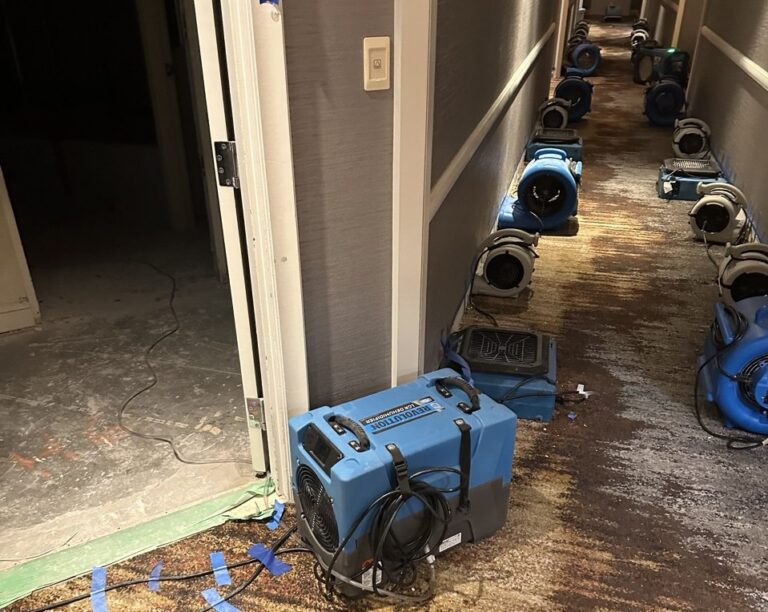
Air movers promote exchange near wet surfaces and can help maintain evaporation. Placement should reflect assembly geometry and actual moisture distribution. Excessively forceful airflow may spread dust or contaminants where containment is required, while indiscriminate use can waste energy without improving drying of shielded materials. Equipment position should be reviewed against repeat measurements rather than left unchanged solely because fans are running.
5.3 Refrigerant and desiccant dehumidification
Refrigerant systems cool air to condense and collect water vapour; desiccant systems use sorption materials and regeneration to remove moisture. Their relative suitability depends on ambient conditions, capacity, energy use, access, containment and the drying objective. Neither category can be declared universally superior without comparable operating conditions and outcome data. Equipment specifications and collected-condensate observations can inform decisions, but neither alone establishes that concealed building materials are dry [1, 2].
5.4 Heat and specialized cavity drying
Controlled heat may accelerate evaporation under suitable conditions, but overheating can damage finishes, warp wood, affect adhesives or move vapour toward colder portions of an assembly. Cavity-specific drying methods can be considered after contamination, construction details and hazard controls have been assessed. The choice to inject or exhaust air through an assembly requires particular care in contaminated losses and fire-separated or otherwise sensitive building elements.
6. Moisture Measurement and Drying Verification
Moisture meters may be invasive (pin-type resistance), non-invasive (dielectric or capacitance-based) or use specialized probes. Readings may be affected by material species, density, thickness, temperature, salts, metal fasteners and instrument settings. Some meters display wood moisture content as a percentage; others provide comparative or relative scales. These outputs are not interchangeable and should not be represented as universally equivalent measures of moisture content.
Verification should combine repeat measurements at consistent locations, reference readings from comparable unaffected materials, trend assessment and recognition of instrument uncertainty. Inaccessible interfaces may require additional testing or carefully selected openings when justified. A decreasing meter number does not automatically establish a safe drying endpoint, particularly when equipment has shifted the distribution of water or readings are taken at a different depth.
A defensible drying endpoint is a project-specific determination, not simply “four days of fans,” a particular RH number or an unqualified universal wood-moisture threshold. Decisions should reference the applicable standard, material condition, reasonably comparable unaffected materials, restoration scope, and any manufacturer or specialist requirements. When readings plateau or increase, the practitioner should reassess unresolved sources, inaccessible reservoirs, equipment capacity and the suitability of continued drying [1, 2].
7. Material-Specific Considerations
Gypsum board and finishes. Gypsum board can absorb water at cut edges and interfaces. Its recoverability depends on duration, contamination, physical condition, cavity configuration, finish permeability and other site factors. Cosmetic restoration should not conceal damp substrate or unresolved contamination.
Solid wood and wood-based panels. Wood moisture content responds to environmental conditions over time. Resistance-based measurements may require appropriate species and temperature correction. Repeated readings and dimensional observations can aid decisions. Swelling, delamination and bond degradation may persist even after free moisture has been reduced.
Concrete and masonry. Dense or thick assemblies may hold moisture and exhibit gradients that a shallow surface reading misses. Suitable testing methods and acceptance criteria depend on intended flooring or coating systems. Do not equate a dry surface with readiness for moisture-sensitive floor covering installation.
Engineered flooring and layered assemblies. Layers of adhesive, underlayment and finish can restrict drying paths. Low-profile drying systems may be considered for some assemblies, but success must be verified; latent cupping, crowning, buckling or adhesive failure can emerge later. Any recommendation to retain flooring should acknowledge these possible delayed effects.
Insulation and enclosed cavities. Wet insulation may lose performance and be difficult to verify without access. The decision to remove or dry in place depends on type, contamination, drying feasibility, access and the full assembly. Damage to vapour-control or air-control layers during opening must be appropriately repaired.
8. Illustrative Decision Scenario (Not an Actual Case Study)
Consider a hypothetical townhouse in coastal British Columbia with a supply-line leak affecting the kitchen floor and the ceiling below. This scenario contains no actual project measurements, dates or Novaco job results; it is included only to demonstrate how the reviewed principles might guide field practice.
At the first visit, a restoration team would establish that the supply line had been repaired, screen for electrical and material hazards, document the visible water paths and map accessible materials. The team would record reference measurements from comparable unaffected components and note any areas for which readings are unreliable or impossible. Bulk extraction would precede equipment placement. If testing and risk review supported drying in place, air movement and dehumidification could be introduced with attention to air paths, adjacent spaces and finish materials.
During subsequent visits, the crew would repeat readings at marked points, capture indoor psychrometric conditions and look for differences between the floor surface, underside and edge conditions. If the accessible surfaces trended down while readings beneath the floor remained elevated, the drying strategy would require reassessment; this might involve selective access, alternative equipment or removal when recovery is not defensible. The team would not declare success merely because a dehumidifier collected water or the top floor felt dry.
The illustrative endpoint would be documented only after readings and observations supported an appropriate material-specific goal, the leak remained resolved, relevant concealed risks had been addressed and the planned repair system could be installed within its moisture requirements. This scenario is an analytical demonstration, not evidence that any named company achieved a specific outcome.
9. Discussion: Evidence, Trade-offs and Uncertainty
Structural drying is a coupled heat-and-moisture process constrained by construction details and by the quality of available observations. Operational guidelines can establish a disciplined workflow, yet they do not provide universal performance estimates for every assembly. A high-capacity dehumidifier cannot compensate for an uncorrected leak; aggressive surface airflow cannot by itself resolve a trapped reservoir beneath impermeable flooring. Selection of equipment must be linked to water source, material exposure, air pathways and measured progress.
A consistent difficulty is separating measurement from interpretation. Readings are instrument- and material-dependent. Trends are often useful, but comparisons must be made in equivalent locations and conditions. Thermal anomalies can prompt investigation, while percentage moisture values and relative scales require different interpretation. Reference or control locations strengthen analysis but may themselves vary because of construction differences or natural material heterogeneity.
Another challenge is balancing material preservation against the risk of hidden moisture or contamination. Drying in place can avoid unnecessary removal where technically appropriate; conversely, demolition may be necessary to address compromised assemblies, contamination and inaccessible moisture. Decision-makers should explicitly document the limits of available evidence and explain residual uncertainties to occupants, owners and insurers.
This review has important limitations. It synthesizes authoritative guides and building-science principles rather than pooled controlled trials. It does not compare drying technologies experimentally, quantify expected time-to-dry, specify universal instrument thresholds or establish a measured case outcome. ASHRAE and EPA building-moisture guidance extends beyond restoration operations, and the WHO guidance concerns dampness and health rather than equipment engineering. Detailed applications must follow the full applicable standards and competent field assessment.
10. Practical Documentation Framework
For each affected material or assembly, a transparent restoration record should capture:
Event description, likely source, discovery time and source-control status.
Safety and contamination screening, including testing needs before disturbing suspect materials.
Construction description, accessible boundaries and suspected concealed pathways.
Moisture map, instrument make/model, mode, positions, reference readings and limitations.
Psychrometric measurements with location and timestamps.
Equipment type, capacity and placement, plus any adjustments over time.
Dated moisture trends and explanations for stagnant or anomalous results.
Material-specific endpoint criteria, final verification and unresolved limitations.
Salvage versus removal rationale, including potential delayed damage.
Photographs, authorization, communications and final recommendations.
A completed record allows a later reviewer to understand not only what was done, but why decisions were made. Where observed conditions fall outside normal restoration competence, qualified hygienists, engineers or other specialists should be consulted.
11. Conclusion
Effective structural drying cannot be reduced to a fixed equipment package or an assumed number of drying days. It is a documented sequence of assessment, source control, water removal, environmental management, material-specific monitoring and endpoint verification. Understanding capillary wetting, vapour movement, evaporation and measurement limitations makes drying decisions more transparent and less dependent on surface appearance alone. The strongest operational conclusions are those supported by observations at the specific building and by applicable standards; where evidence is incomplete, residual uncertainty must be stated. Future field studies using standardized measurement protocols and comparable assemblies would help test equipment strategies and develop more reliable performance comparisons.
Related Novaco Resources
For an overview of professional drying methods and services, see Structural Drying & Dehumidification and Emergency Water Extraction. These service resources complement the technical discussion above.
References
- Institute of Inspection, Cleaning and Restoration Certification. (2021). ANSI/IICRC S500-2021: Standard for Professional Water Damage Restoration (5th ed.). ANSI Webstore (official standard listing and scope). https://webstore.ansi.org/standards/iicrc/ansiIICRCs5002021
- ASHRAE. (2025). ASHRAE Handbook—Fundamentals, Chapter 37: Moisture Management in Buildings. https://handbook.ashrae.org/Handbooks/F25/SI/F25_Ch37/F25_Ch37_si.aspx
- World Health Organization Regional Office for Europe. (2009). WHO guidelines for indoor air quality: Dampness and mould. WHO. https://www.who.int/publications/i/item/9789289041683
- U.S. Environmental Protection Agency. (2013). Moisture Control Guidance for Building Design, Construction and Maintenance. EPA 402-F-13053. https://www.epa.gov/indoor-air-quality-iaq/moisture-control-guidance-building-design-construction-and-maintenance-0
- U.S. Environmental Protection Agency. (n.d.). Mold cleanup in your home. https://www.epa.gov/mold/mold-cleanup-your-home